


Thoughts on China via Movies on DVDs
- This topic has 13 replies, 2 voices, and was last updated 13 years, 8 months ago by
Anonymous.
-
AuthorPosts
-
May 14, 2012 at 6:04 am #20399
Anonymous
GuestThe short lived Qin Dynasty can better be understood when one views this film. The roles of the characters where undoubtedly scripted from both primary records and secondary sources. The use of Chinese as the base language was well chosen. Subtitles, though a bit irritating, did allow the viewer to assess the universal language of 'body talk'. The actors did a brilliant job at using their entire person to express their communications. Thanks to this seminar and our study of Chinese philosophy I spent the hours viewing the film trying to label what school of thought each actor's role was moulded around. After viewing so much intrigue and slaughter I was surprised that I didn't experience a nightmare. Definitely an 'R' movie. It makes me wonder what the Buddha would have thought of this film. Hmmmm
May 15, 2012 at 1:59 am #20400GuestAre we posting here or the other thread or both??
May 18, 2012 at 5:58 am #20401GuestGood question. I posted a film review on the other film thread. Should I copy it to this one?
May 20, 2012 at 12:52 pm #20402GuestI will post my review on the other one, in the meantime, here is a list of films that I brought into class the other day. I was told all of them were good films to watch and review:
The Promise
Seven Swords
The Banquet
WarlordsMay 30, 2012 at 4:42 am #20403GuestVARIETY magazine describes this film as a 'Must -See! Thought - Provoking and Achingly Hilarious' film, and the pitch is no exaggeration. The action is centered on a election for a classroom monitor. The teacher submits three nominees; two boys and one girl as candidates for election. The politicking begins for votes, and the 'wheeling and dealing' portrays a wide range of strategies akin to those used in the United States by 'Tammy Hall' or in the 'smoke filled rooms' at party conventions. The candidates first present their platform and the debating begins. The action is humorous and energetic. The presentations are marvelous. Chinese 8 year olds using democracy to win an election. Truly a tantalizing film that fills the imagination of a non-communist viewer with the thought that maybe the Peoples Republic of China will one day have a truly legitimate constitutional document starting with the words WE THE PEOPLE!
edited by rnuranen on 5/30/2012June 3, 2012 at 12:29 pm #20404GuestI want to go see this movie, it seems so interesting and if someone has seen it, PLEASE, post a review. I am looking for theaters but it seems it was a limited engagement.
"Jiro Dreams of Sushi"
http://www.rottentomatoes.com/m/jiro_dreams_of_sushi/trailers/
June 7, 2012 at 4:22 pm #20405GuestI really wanted to watch "Cape #7". I called most video stores in the San Gabriel area, but have yet to find a English Subtitle version.
June 20, 2012 at 12:08 pm #20406GuestWhich thread are we to post the movie review? I only see this one and not the other one people commented on. Help!
June 20, 2012 at 1:02 pm #20407GuestMy daughter, who enjoys learning about Asian cultures, found this movie for me and thought I should review it for the assignment. She was right...this movie turned out to be interesting, enlightening, and informative. The story is about two girls, Nina and Sophia, who are best friends and are taught about Laotong, a unbroken friendship between two girls that is more like a sisterhood. This tradition was practiced by the Hunan and included a contract that was signed by both girls to symbolize the commitment they were making to each other. The two girls agreed to be each other's friend, confident, and support since the times in which it was practiced were difficult and harsh. Many girls were married off to men they didn't know or love and a laotong provided unconditional love. The girls also learn a special oral and written language called Nushu, a language that only the laotong knew and was a symbol of their bond. Both girls live in present-day Shanghai.
Once the girls learn about laotong and sign their contract, they learn about Sophia's great-great-great-great grandmother, Snowflower and her laotong, Lily. The girls are joined during their foot-binding experience, which although not explicitly detailed, does give a general idea of the cruelty involved. Both girls grow up together and are separated by marriage, which is tradition. Since Snowflower is from a privileged class and Lily is from a lower, they don't see each other as often as they'd like. Yet they are together during the Taiping Rebellion in which the movie gives a brief overview of the harshness of that time period.
The movie gives great scenes from Shanghai, modern day and historically, Chinese music and dance, and language. The movie is partly in Chinese and English, which made it fascinating to follow along to.
I would definitely recommend this movie and it would be a great accompaniment to a lesson plan on Chinese culture. It's a movie to be seen again so that you can catch all the details and meaning. It shows the strength of the human bond, a strong historical perspective, and cultural aspects.
June 22, 2012 at 1:19 am #20408GuestCity of Life and Death, directed by Lu Chuan, is a visually stunning film (it was shot in black and white, reminiscent of Speilberg’s Schindler’s List) that tells the story of the Rape Nanjing as experienced by some of the cities Chinese inhabitants, a German businessman, and a young Japanese soldier. In terms of conveying the magnitude of the horrific atrocities exacted by the Japanese army upon the Chinese, this film, while not being as gruesome as it might have been, certainly gets the point across. Of particular interest is the way in which the japanese soldier is presented in the film: as a young man with a soul who is struggling to come to terms with a world gone wrong; certinly this sympathetic portrayal was a source of controversy for many. While overall, an outstanding film that should be seen by many, it is probably a bit too brutal for viewing in your average high school class, due to violence, including a brutal gang-rape scene. I enjoyed the film, but for my class, I will have to stick with excerpts of Iris Chang’s The Rape of Nanjing. Either way, I do think that it is helpful to introduce students to this particular story, alongside the Nazi Holocaust, and the use of the atomic Bomb on Japan, when teaching about the incredible changes in warfare tactics that engulfed the first half of the twentieth century.
edited by bcovey on 6/22/2012June 22, 2012 at 1:20 am #20409GuestZhang Yimou's 1994 film To Live is a sweeping epic which follows one family's struggle to survive throughout the turbulent decades of China's communist revolution covering many of the formative events that contributed to the rise of the Maoist state. There is much to commend in this film for use in the classroom. First of all, it conveys the sequence of the revolutionary procees in China in a much more engaging way than any textbook; therefore it could act as an excellent supplemant to reading assignment sthat students might be assigned in a class. Of particular value, To Live highlights fascinating elements of the revolution, including the Great Leap Forward and the Cultural Revolution, bringing to life the effects that these policies had on a normal Chinese family. Scarcity is experienced by people in order that Industiralization might be completed, even to the point of sacrifice and death; Chairman Mao is revered with cultish loyalty; those most loyal to the revolution find them selves targetted as it s betrayers. I show very few feature films in my AP World History classes, but this one is a gem and the two hours that the viewing requires will be well worth the time spent.
edited by bcovey on 6/22/2012June 22, 2012 at 1:21 am #20410GuestChen Kaige's 1998 epic The Emperor and the Assassin is about China's first Emperor, Chin Shi Huangdi and one of the apparently many assassination attempts made on his life. This is an amazing film, which might be compared to an American film like Mel Gibson's Braveheart. It can be used in a classroom with high school students, however, there are a couple of very brutal and violent scenes. Aside from the pure beauty of this film, one thingstrike me as useful for teaching about ancient China: The film does a great job in portraying the ruthlessness of the Legalist first emperor of a unified China, and the type of relentless leadership that must have been a necessity in bringing China together. There is also a great scene where the emperor, who is finding himself increasingly estranged from his love interest, holds a discussion with her in which there is an interesting contrast between the philosophical values of his Legalism and her (what seems to be) Confucianism. I think that this scene brings up some nice points for discussion.
edited by bcovey on 6/22/2012June 24, 2012 at 7:04 am #3396Rob_Hugo@PortNW
KeymasterThis World War II Steven Spielberg; nearly two hours long film, uses one of G. Ballard's bestsellers to portray life in China as the Japanese were advancing towards Shanghai. Although a large number of foreign nationals had already fled China another group remained hoping in denial that war could be avoided. Such would be the case with with the family of Jim Graham; a teenage boy of 14. In the panic that follows the inevitable assault on Shanghai Jim gets separated from his parents and would begin a three year imprisonment. Although a truly terrible internment, Mr. Spielberg did attempt to present the Japanese both as fascists and behind their veneer some evidence of civility. A thoroughly gripping film that brought me back to the time I spent a day reading THE GRAPES OF WRATH. The Joad family endured one trial after another holding on to hope until the unexpected ending scene. I remember those tears. Once again EMPIRE OF THE SUN brought on tears when Jim was finally reunited with his adoring mother - on Mother's Day no less.
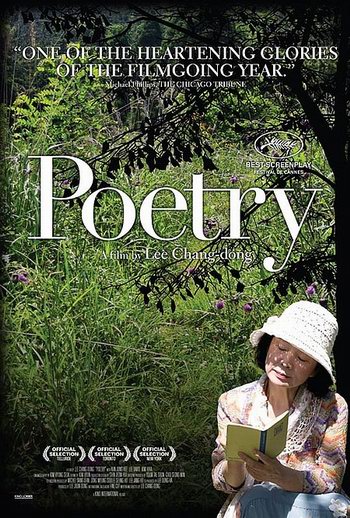
June 24, 2012 at 7:04 am #20411GuestRotten Tomatoes heralded Poetry as "an absorbing, poignant drama because it offers no easy answers to its complex central conflict." and bequeathed its highest rating of 100%, so I knew I had to watch the film.
Poetry is a South Korean film written and directed by Chang-dong Lee in 2010 and stars Yun Junghee as its protagonist, an gracefully aging woman in the earliest stages of dementia, raising her grandson alone on a meager subsistence funded by social security and a part-time job as a maid and caregiver to an elderly disabled man.
The film ends just as gently and poignantly as it begins with the river at the edge of a small town on the outskirts of Seoul. I believe that the water must have been used symbolically to represent various aspects of this story, including the journey of life, renewal, cleansing and ritual purification. The natural landscape was as much a character in this film as were the people. As the title character, Mija, navigates this last phase of her life, upon learning that her inability to remember nouns only precedes the eventual loss of verbs, we watch her come to terms with a world she scarcely understands and struggles to find her voice within.
I don't want to give too much away as the film would not be fulfilling to the viewer if you knew some of the more unsavory details that are integral to understanding and appreciating the delicacy with which the storylines have been masterfully handled by the director. Suffice it to say, the film gave me a glimpse of the convergence of past-oriented traditional ideals and virtues clashing with modern expectations for future-oriented success.
Many of the characters engage in unspeakable acts that are glossed over in order to preserve prospects for future prosperity, all the while observing Confucian rituals of filial piety such as bowing before elders and practicing humility such as casting eyes downward when publicly praised for laudable accomplishments. For instance, I found it quite intriguing that even when it was clear that the nonsensical babbling of the elderly Mija was annoying some of the people she encountered, there was never a moment of disparaging eye rolls or hasty retreats that are more familiar to Western audiences. Perhaps it was that they recognized and expected to find kernels of wisdom in the musings and commentary of the esteemed elderly and when I considered it from that perspective I found myself feeling less annoyed and more compelled to hear what Mija had to say.
I think that is the true beauty of this film; if we can learn to listen more and talk less we may find enlightenment in the everyday truths even if they baffle or disgust us.
-
AuthorPosts
- You must be logged in to reply to this topic.